
25 for ’25 Honoree: Jophy Lin
We’re celebrating ten years of the Congressional App Challenge by spotlighting 25 outstanding young alumni shaping the future of technology and innovation. On these pages, you’ll meet the honorees, explore their journeys from CAC competitors to changemakers, and see where they’re headed next.
About Jophy Lin
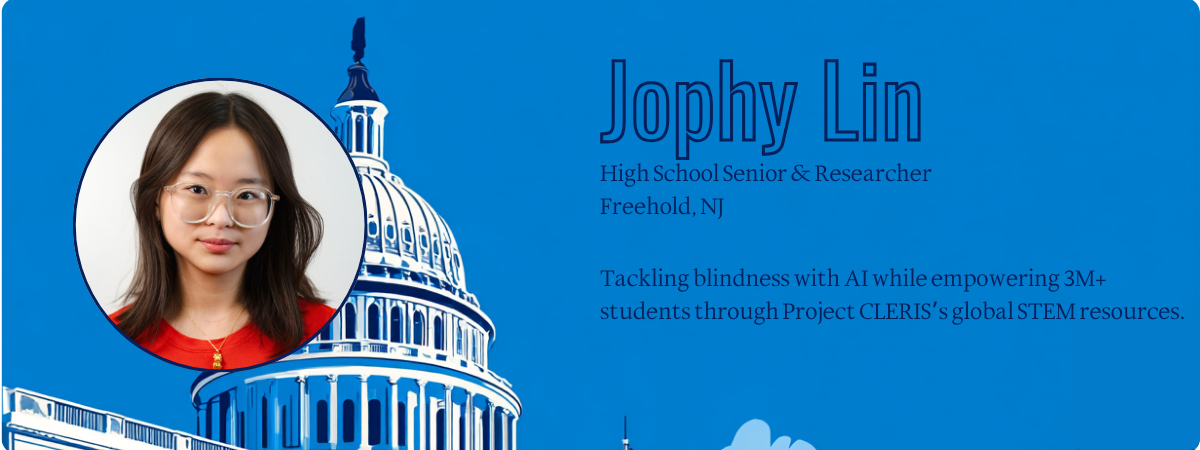
Jophy Lin, 17, was recognized as a finalist in New Jersey’s 4th District Congressional App Challenge in 2023. A two-time ISEF finalist, she is a high school researcher and nonprofit leader expanding global access to STEM resources.
CAC: How did participating in the Congressional App Challenge contribute to your personal journey, career path, and accomplishments so far?
JL: The Congressional App Challenge (CAC) taught me to see coding not as something done in isolation, but as a way to advocate for others—using technology to solve the problems my community faces. It reshaped how I approach research, leadership, and mentorship. As a first-generation college student, I’m passionate about learning and widening access to STEM education, which has shaped nearly everything I do. I was accepted as one of 64 into the Governor’s School of Engineering & Technology, where I completed college-level coursework and researched. I also co-lead Project CLERIS, a nonprofit providing free scientific resources, reaching 3,000,000+ people in 100+ countries with 80,000+ active users, including a flagship research course with 30,000+ learners. As the first and only student in my district to qualify for ISEF, I have been recognized locally, statewide, and nationally for my research and volunteerism advancing scientific innovation and education. All of this traces back to the mindset the CAC taught me, and I’m more than glad to have participated!
CAC: Try to remember back to competing in the CAC – what was your app about and why did you create it?
JL: Back when I competed, I built CultureConnect, an app designed to combat childhood social isolation while promoting cultural awareness and language learning. At its core, the app combines a compatibility-scoring algorithm with AI-driven language tutoring to match kids with “pen pals” across the world, creating connections that are both meaningful and educational. I engineered the backend using Firebase for authentication, a cloud database for communication, and multiple APIs so children could not only exchange digital “letters” with each other but also learn new languages. I created this because I saw how easily technology can isolate children, even while connecting us superficially. Many kids in nations that are more developed have limited exposure to diverse realities, while kids in less-resourced regions often lack platforms to share their voices. CultureConnect bridges that gap, nurturing empathy, cross-cultural understanding, and collaboration among the next generation.
CAC: What are you most proud of in your academic or professional career thus far?
JL: In one of my favorite books, I Know Why the Caged Bird Sings by Maya Angelou, she wrote, “The quality of strength lined with tenderness is an unbeatable combination, as are intelligence and necessity when unblunted by formal education.” That is now one of my core values. What I’m most proud of isn’t the projects I’ve finished or the skills I’ve learned, but how I’ve used them to make a difference. To me, strength means staying determined through challenges, but tenderness means using that determination to lift people up, not just push forward alone. And intelligence matters most when it’s paired with necessity, finding creative ways to solve problems and share knowledge where it’s needed most. Looking back, the moments that mean the most to me are when my efforts have touched someone else’s path, and that’s the legacy I’m proud of, because, as Angelou reminds us, “your legacy is every life you have touched.” That is the legacy I hope to leave.
CAC: Let’s look into the future – where do you hope to be in 2035?
JL: By 2035, I’ll be 26 or 27, and even though I’m still not sure whether a master’s or PhD will be part of my path, I hope to have built a nonprofit dedicated to expanding STEM education. My intention is to take the free resources I’ve created and grow them into something that reaches students worldwide, especially in underprivileged areas. I want to travel around the world to communities where opportunities are limited, work with students, listen to their dreams and goals in life, and help give them the tools to pursue them. It’s honestly a little scary to imagine so far down in the future, but I know that I would want to work in some field of computer science or engineering, and also be actively involved in the policy aspect of education. I want to be a leader who not only creates new technologies but also works alongside legislators and educational systems to ensure that there are stronger, more inclusive programs in STEM. I hope people can look at my work and see someone who cares enough to make opportunities available to others, and someone who believes that every student, no matter where they come from, deserves a chance to pursue their dreams, regardless of background, because I truly believe it’s possible with the right support and belief in their potential.
CAC: What excites you most about the future of technology and innovation?
JL: There’s a lot of things I think are really amazing about what’s been going on in technology and innovation today. But most of all, I think it’s quite exciting how in today’s society, the power to create is no longer given to just elite labs or professionals. It’s quite cool seeing how it’s now expanding to anyone with curiosity, creativity, and access to the right tools. In fact, a lot of high schoolers can now design things that initially seem well beyond their years. And I think it’s really cool and important how opportunities like the Congressional App Challenge show this change happening currently: they give students a platform to showcase their work publicly, no matter their background or resources, and remind us that innovation is best when more voices and perspectives are included. For me, the most exciting part of the future is not simply the technology itself, but the fact that more people than ever before will have the chance to shape where it goes and who it serves.
Links Learn more about Jophy Lin
LinkedIn: https://www.linkedin.com/in/jophylin