
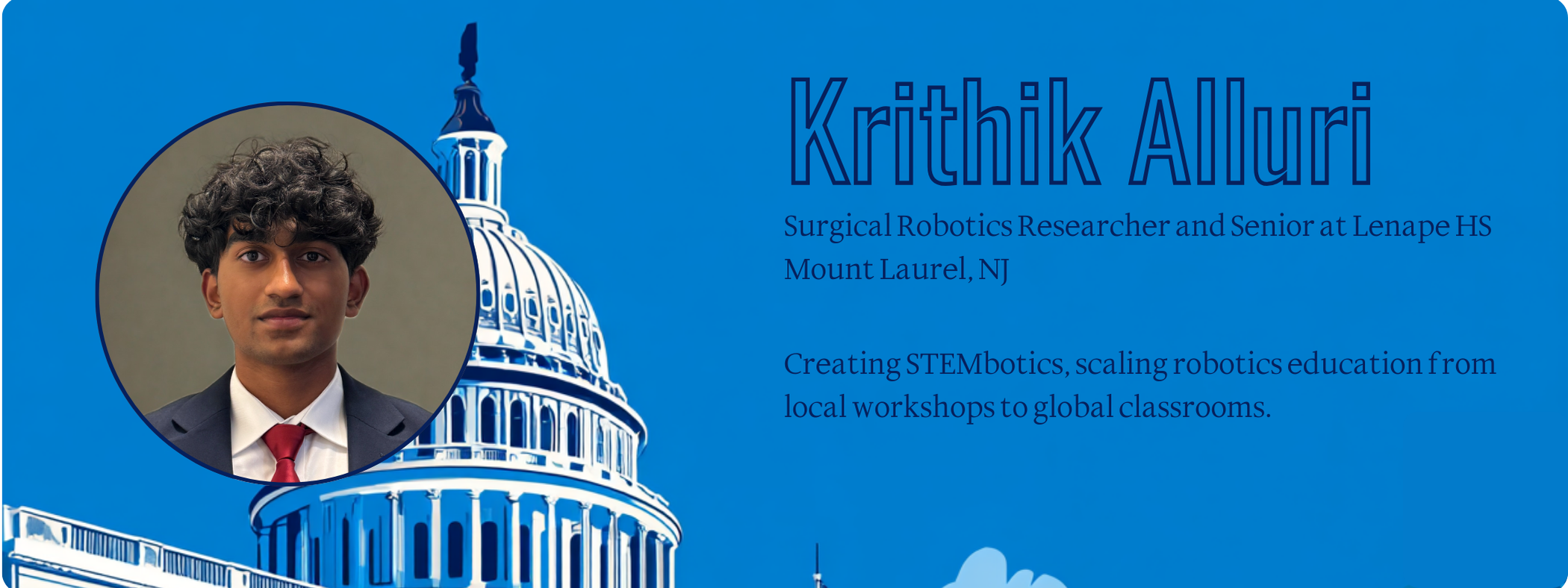
25 for ’25 Honoree: Krithik Alluri
We’re celebrating ten years of the Congressional App Challenge by spotlighting 25 outstanding young alumni shaping the future of technology and innovation. On these pages, you’ll meet the honorees, explore their journeys from CAC competitors to changemakers, and see where they’re headed next.
About Krithik Alluri
Krithik Alluri, 17, won the Congressional App Challenge in 2024 in New Jersey’s 3rd District. He is a researcher in surgical robotics and the founder of Stembotics, a nonprofit bringing low-cost STEM education to students.
CAC: How did participating in the Congressional App Challenge contribute to your personal journey, career path, and accomplishments so far?
KA: The Congressional App Challenge was the first time I was pushed to stop treating my project like a hobby and start treating it like a real product. It was a catalyst that shifted my mindset from just building for myself to building for a community. The competition forced me to think beyond the technical challenges and articulate not just what my app was, but who it was for and why it mattered. The second, and perhaps even more valuable, part was the community. Connecting with other student developers who were just as passionate about using tech for good was huge. It gave me a network of like-minded people. Listening to the keynote speakers and connecting with the judges wasn’t just about getting feedback; it was about seeing different career paths and learning how to tell a powerful story about your work. That experience of connecting with people has shaped my approach to everything I do.
CAC: Try to remember back to competing in the CAC – what was your app about and why did you create it?
KA: My project was a brain-controlled wheelchair that I built to help people with neuromuscular disorders regain some independence. I was inspired by my grandfather’s stroke and his journey to regain mobility, and I wanted to create a low-cost, accessible path for others. My system used an EEG headset to interpret simple commands, forward, left, right, stop, and send them to the wheelchair’s microcontroller. But what made it more than just a proof of concept were the features I added: a quick calibration process, real-time feedback on the user’s brain signals, and an emergency stop. It was a huge challenge to take something I’d only ever sketched on paper and make it into a system that could safely and reliably move a real chair.
CAC: What are you most proud of in your academic or professional career thus far?
KA: I’m most proud of being able to contribute to the cutting-edge development of surgical robotics. Knowing that I’m part of building a future where surgical procedures are safer and more intuitive is a huge source of pride. The work feels incredibly important and useful. It’s not just about pushing the boundaries of technology, but about applying it to directly improve patient outcomes and transform how care is delivered.
I’m also incredibly proud of starting Stembotics. We’ve delivered low-cost STEM learning to over a thousand students, and seeing the impact on those kids is a completely different kind of fulfillment. Leading teams, writing curricula, and shipping physical kits have been a massive learning experience, and it’s deeply rewarding to empower the next generation of innovators.
CAC: Let’s look into the future – where do you hope to be in 2035?
KA: I don’t have a rigid ten-year plan, but my long-term goal is to get my MD and become a doctor. I want to be on the front lines of patient care, but also bring my background in technology to the field. I see a future where I can use my expertise in robotics and software to build better tools and systems for clinicians, directly enhancing patient lives.
Beyond my own career, I want to be a change-maker within STEM. I want to be someone who inspires other people to create, innovate, and solve problems regardless of their background or circumstances. The most exciting part of the future of technology is that the power to create is expanding beyond just elite labs and professionals. In 2035, I hope I’m a leader who not only builds new technologies but also helps ensure opportunities are available to everyone, because I truly believe every student deserves a chance to pursue their dreams
CAC: What excites you most about the future of technology and innovation?
KA: What truly gets me out of bed in the morning is the rapid advancement of robotics and its convergence with AI. I’m especially excited about the potential for smarter, more intuitive surgical robotics. The idea that these systems can make complex procedures safer, reduce complications, and ultimately make advanced healthcare more accessible worldwide isn’t just exciting; it’s a powerful motivator. This is a field that perfectly combines my love for engineering, my desire to help people, and the incredible potential of cutting-edge technology. The future of healthcare isn’t just about faster scans or new drugs; it’s about fundamentally reinventing how we deliver care.
Links Learn more about Krithik Alluri
LinkedIn: https://www.linkedin.com/in/krithik-alluri/
Instagram: https://www.instagram.com/krithik_alluri/