25 for ’25 Honoree: Nick Harty
We’re celebrating ten years of the Congressional App Challenge by spotlighting 25 outstanding young alumni shaping the future of technology and innovation. On these pages, you’ll meet the honorees, explore their journeys from CAC competitors to changemakers, and see where they’re headed next.
About Nick Harty
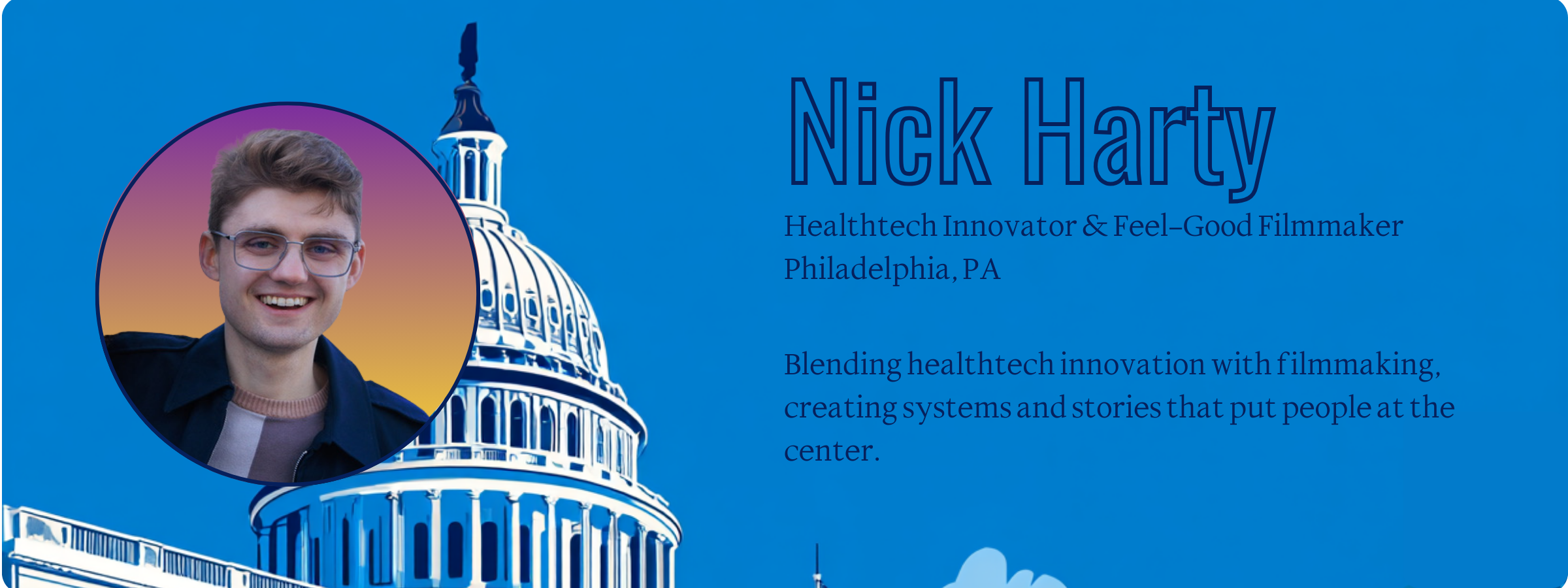
Nick Harty, 20, won the Congressional App Challenge twice in 2021 and 2022 in Florida’s 19th District. He is a healthtech innovator and filmmaker, building Medibound to transform patient monitoring and Storiara to simplify film production.
CAC: How did participating in the Congressional App Challenge contribute to your personal journey, career path, and accomplishments so far?
NH: The Congressional App Challenge was the spark that turned my curiosity into a life purpose (career?? we’ll see). Our original app focused on patient privacy and giving people ownership over their medical data, built on the EHR (FHIR) protocols I started exploring back in sixth grade (started because I was bored in Algebra… more on middle school later).
Here’s a news clip from the time: https://www.instagram.com/p/Cb6L8IYACAV/
From there, Medibound evolved into a medical device software platform to help startups accelerate development. Today, it has pivoted into agentic patient monitoring… connecting wearables to automate triage and follow-ups for clinics.
Each iteration taught me to pivot boldly, stay close to the problems real people face, and embrace a community I love serving. That mindset has defined my path as both a founder and a builder.
CAC: Try to remember back to competing in the CAC – what was your app about and why did you create it?
NH: Shocker! It was Medibound. But a different Medibound. At the time, we built it around patient privacy, giving people more control over their medical records. We saw how broken the system was. How hard it was to share records or simplify data for the consumer. That idea became the seed for everything that followed.
But let’s rewind the clock: 9 years this fall. Aum (my best friend) and I met in 6th grade and quickly realized how much we both, oddly enough, loved numbers. We’d compete to see who could solve problems faster as we dragged Math Team practice hours way past the last bus. From rivals in algebra to late-night best friends, in high school we started a world champion robotics team and opened community makerspaces. We prototyped retinal diagnostics for diabetics, red tide mesh sensors, and urban navigation tools for the blind.
When I had to move to New York in junior year, we didn’t quit. We kept competing together in science fairs, invention challenges, and business plan prizes. And when we split for college—Princeton for Aum, Penn for me—we still didn’t quit. We launched a company to be the change we hoped to see in healthcare.
That’s ultimately what I hope for everyone who competes in the App Challenge. That’s why I’m so passionate about being on the alumni board. To make friends. To solve real problems for real people. And to strive for a purer difference that lasts.
CAC: What are you most proud of in your academic or professional career thus far?
NH: Nothing. To be quite honest, I’m stuck on what I haven’t done, I can’t even imagine what I’m proud of
What I value most are the moments when something I built or shared made a real impact on others.
An example could be Live A+ Little, a short film I directed and edited with a dozen close friends about rediscovering connection in a distracted world. I’ve made a film every summer for the past eight years, but that one stood out. When we screened it in my hometown, I saw tears in the eyes of community members who felt truly seen.
Or mentoring younger founders in Penn’s healthcare incubator, replying to long emails from underclassmen wrestling with self-doubt, or just noticing the little things my friends are going through and being there in quiet ways that matter.
If there’s a thread across it all, it’s this: I’m a dreamer who cares and a doer who listens.
CAC: Let’s look into the future – where do you hope to be in 2035?
NH: God, I don’t even know where I’ll be tomorrow… and that’s what makes the future exciting. My goals for 2025 are really the same as my goals in life.
1. I’ve only ever been obsessed with two lanes: healthtech and film. On the health side, I want to keep pushing toward the promise of true preventative care we were told was possible during the pandemic, and to help build a healthcare system that’s more equitable and accessible for everyone.
2. In film, I want to make storytelling seamless. As a director and writer, there are three films I feel I have to make before I die. They’re stories I’ve carried with me for years—about love, loss, and society and they’re the dent I want to leave in the world.
3. And above all, wherever I am in 2025, I hope I’m spreading a love that lasts.
CAC: What excites you most about the future of technology and innovation?
NH: Ok here’s the boring, venture capital-esque, nerdy answer…
Growing up in Southwest Florida, where hurricanes often collapsed power grids and pushed hospitals past their limits, I learned early that infrastructure only matters if it works when everything else breaks. That mindset has shaped everything I build, whether patient monitoring flows, legislative bill analyzers, or film pre-production pipelines, driven by the belief that complex systems should be made usable, intuitive, and scalable.
I am most excited about what I call invisible infrastructure: agentic systems that slip into existing workflows and quietly make them faster, smarter, and more reliable. OpenSight, for example, resolves support tickets end to end by acting directly in backend systems, while Shortcut embeds AI agents inside Excel to radically speed up modeling. These tools do not ask users to change behavior, they just work. In a world where software can be swapped overnight, the real moat is delivering consistent, compounding utility and earning lasting trust.
Perhaps more controversial, I am most skeptical of relational AI startups like You, Only Virtual, which simulate emotional connection through grief tech. They may spark headlines, but they raise ethical concerns and rarely integrate into core workflows. Unlike invisible infrastructure that compounds value, relational AI risks feeling intrusive, inauthentic, and unsustainable at scale.
Short-term hype products centered around simulating/automating relationships = bad
Real impact, invisible infrastructure that accelerates sustainable goals = good
Links Learn more about Nick Harty
Legismaker Website: https://legismaker.com/
LinkedIn: https://linkedin.com/in/nicksheaharty
Instagram: https://instagram.com/nicksheaharty