25 for ’25 Honoree: Arjun Karanam
We’re celebrating ten years of the Congressional App Challenge by spotlighting 25 outstanding young alumni shaping the future of technology and innovation. On these pages, you’ll meet the honorees, explore their journeys from CAC competitors to changemakers, and see where they’re headed next.
About Arjun Karanam
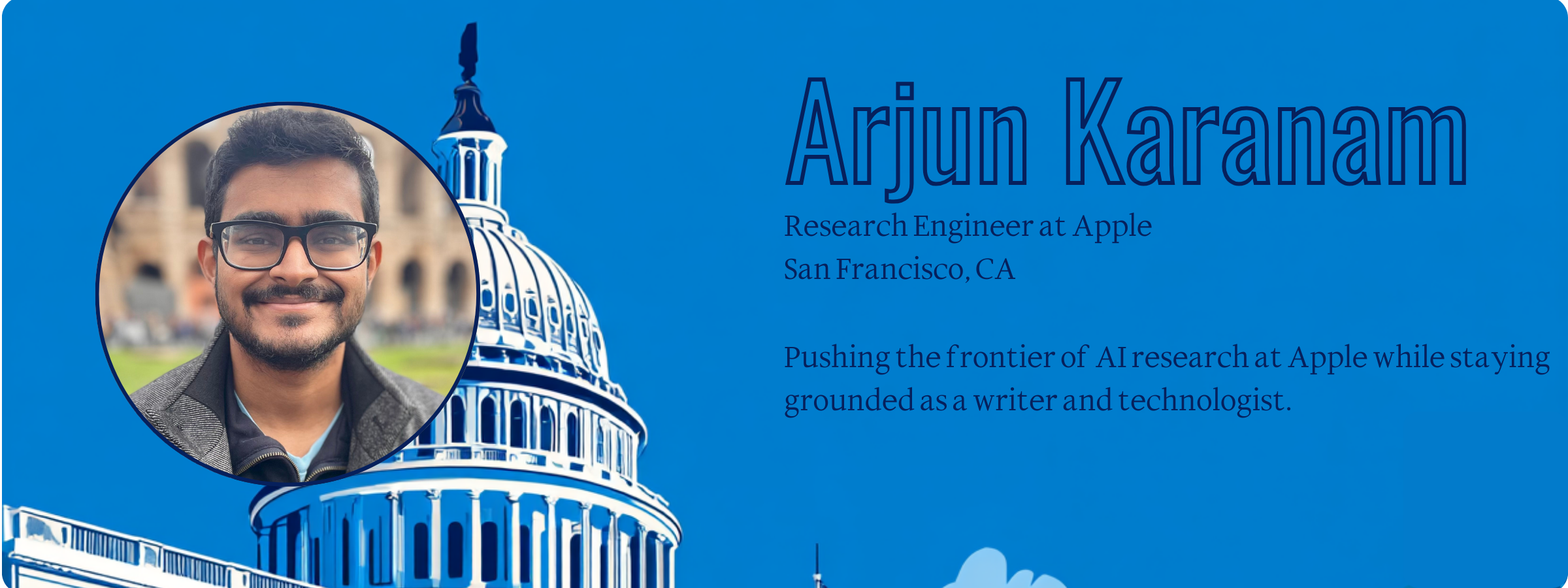
Arjun Karanam, 25, won the Congressional App Challenge in 2015 in Georgia’s 7th District. A Stanford graduate, he is now a Research Engineer at Apple, working on multimodal generative AI and products like Vision Pro, with a focus on aligning cutting-edge technology to real-world impact.
CAC: How did participating in the Congressional App Challenge contribute to your personal journey, career path, and accomplishments so far?
AK: When I entered the Congressional App Challenge, I thought I was just building an app for fun. What I didn’t expect was how much it would change the way I saw technology. For the first time, I saw code connect to something bigger – real people, real communities, and the way decisions are made. Meeting my Congressman made politics feel less abstract and more approachable, like something I could actually be part of. Since then, I’ve always sought to connect whatever I’m working on to the real world, to something that can tangibly touch people’s lives.
CAC: Try to remember back to competing in the CAC – what was your app about and why did you create it?
AK: Ah, I still remember it well! My app was called Electoral College History. It let people scroll through every U.S. presidential election, year by year, with interactive maps of the results. I built it because I’ve always been fascinated by history and wanted to give others a way to see it come alive through technology. Instead of just reading numbers or memorizing outcomes, you could trace how voting patterns shifted over time. How new states entered the Union, how coalitions rose and fell, and how turning points like the Civil War or the Great Depression reshaped politics. The process of creating the app taught me how powerful visualization could be in telling stories. It was also one of the first times I realized I could use code to tell a story, not just solve a problem. And that’s a lesson I’ve used in everything I’ve made since.
CAC: What are you most proud of in your academic or professional career thus far?
AK: What I’m most proud of is learning how to turn research into products that matter. My Master’s thesis at Stanford asked how democratic theory might guide the alignment of large language models – essentially, how abstract ideas about representation and governance could shape the design of these intelligent systems. At Apple, I’ve carried that same mindset into practice, working on generative AI and Vision Pro experiences that make cutting-edge multimodal models usable by many. The throughline is realizing that what makes research is most valuable is when reshapes how people interact with technology day to day. Taking an idea from a paper, pressure-testing it against real constraints, and then seeing it show up in a product is what excites me most. That magical moment of “wow, I didn’t know this was possible,” is what I chase with everything I build.
CAC: Let’s look into the future – where do you hope to be in 2035?
AK: Maybe it’s a little idealistic, but I think about my career in arcs. The first is my tech arc, where I’m focused now – exploring generative AI and multimodal systems, and asking how they can be shaped to expand human creativity and interaction. The second arc is public service, where I hope to carry those lessons into the policy realm, shaping how society governs emerging technologies and ensuring they advance democratic and civic goals. By 2035, it’d be nice to be in that second arc, preferring answering questions around how our institutions that increasingly mediates human experience and decision-making. And then, as a last hurrah, I’d really like to write a novel someday. Preferably Sci-Fi or Historical Fantasy.
CAC: What excites you most about the future of technology and innovation?
AK: I really believe that we’re on the cusp of unprecedented technological change – and as with any change, this can either go really well, or really poorly. What excites me most is not just the pace of innovation, but how mutable it is. So many things we take for granted today (take something as simple as the Qwerty key board for example) are path dependent shaped as much by historical accidents as by intentional design. In this moment of rapid technological change, we have a rare opportunity to rethink those defaults and ask: what kinds of interfaces, norms, and institutions do we actually want to build? And I can’t think of a more exciting question to answer.
Links Learn more about Arjun Karanam
Arjun’s Website: http://arjunkaranam.com