Meet Our Spring 2026 Interns!
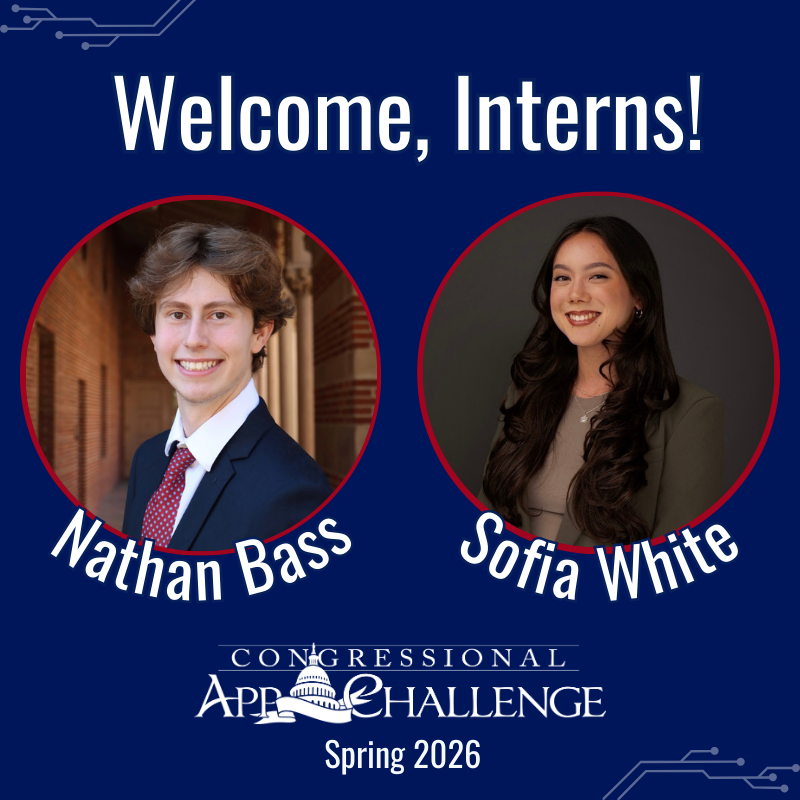
The Congressional App Challenge is pleased to welcome our new Congressional Affairs Interns, Nathan Bass and Sofia White. They join the team at a significant moment for the program—in the 2025 Congressional App Challenge, we’ve reached more students than ever before, with over 14,000 students submitting 4,650 apps. This record-breaking participation highlights the growing impact of STEM education and innovation nationwide. With 394 Members of Congress supporting the Challenge, it continues to be a powerful, bipartisan initiative at the intersection of tech and policy. With strong early momentum, Nathan and Sofia will play a valuable role in supporting the continued growth and success of the 2026 #HouseOfCode.
As part of the Congressional Affairs team, they will assist with congressional outreach, provide logistical support, and contribute to key initiatives aimed at strengthening engagement with both congressional staff and student participants. Their commitment to public service and interest in technology policy make them strong additions to our team. We’re excited to have them on board—learn more about Nathan and Sofia below.
Educational Background
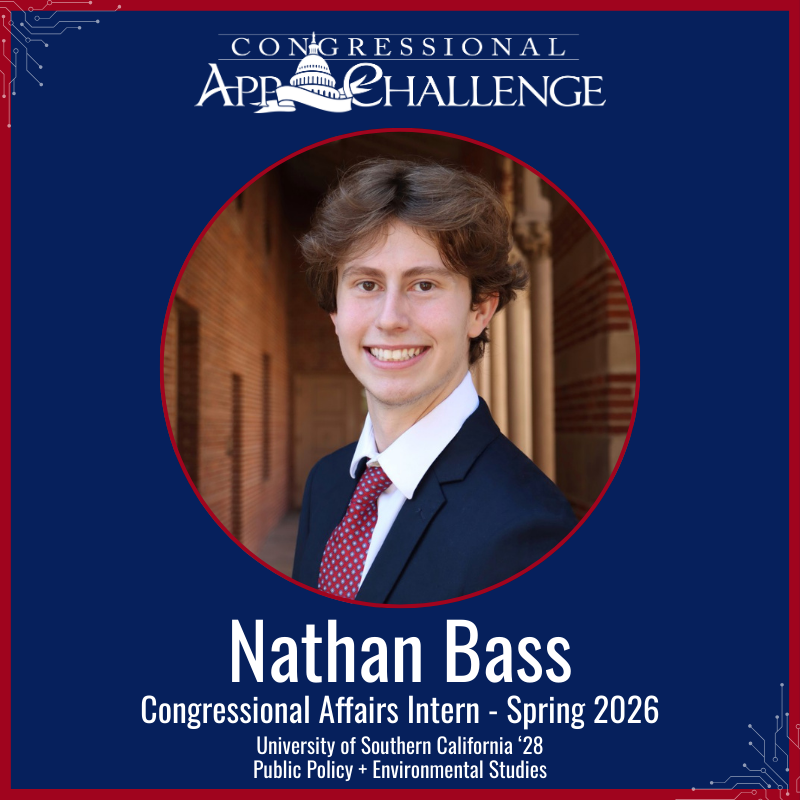
Hey! My name is Nathan, and I’m from McLean, Virginia. I am currently a Sophomore at the University of Southern California, studying Public Policy and Environmental Studies. I’m thrilled to be studying in D.C. this semester through the USC Price Semester in D.C. program!
Why did you want to work for the IEF, specifically the Congressional App Challenge?
I’ve always felt connected to the field of education. I come from a long line of teachers, which has exposed me firsthand to both the complexities of educational work and the far-reaching impacts that quality and compassionate educators can have on their students. Additionally, I worked with USC’s Joint Educational Project last Spring, helping teach local kindergarteners about environmental issues. Actually serving as an educator, especially in an underserved and underfunded school district, opened my eyes to the world of difference that adequate resources and educational accessibility can make in supporting future generations of bright thinkers. With tech, coding, and internet topics set to shape the future of almost every major industry, I found the mission of the IEF and the App Challenge to promote student engagement and innovation in these areas incredibly important, and I’m so excited to contribute to that!
What’s a STEM/internet policy topic that’s most pressing to you?
As an environmentalist, I am fascinated by the capacity of new technologies to both harm and benefit our planet. A persistent buzz exists around the degradative potential of Rare Earth Element mining and AI water usage/electrical grid strain, issues that I care deeply about. However, both Rare Earth Elements and AI could have long-term environmental payoffs in their ability to contribute to clean energy and greenhouse gas mitigation technologies. I am intrigued by the intersection of these positive and negative potentials, and hope to continue to learn about the climate and environmental justice implications of technological advancements.
What’s the most exciting thing you’ve learned so far during your internship?
Beyond witnessing the amazing ways students all across the country are leveraging coding and technology to serve their communities, it has been incredibly exciting to see how much is constantly going on in the tech sphere! From a student somewhat less familiar with tech policy, attending and contributing to such massive tech events has been incredibly interesting! Specifically, I was really intrigued by a lightning talk at State of the Net that discussed the role of Public Utility Commissions as a local quasi-policymaking tool to determine where data centers get built.
Fun fact to share about yourself!
I was the longest baby born in Singapore in the year of 2006!
Educational Background
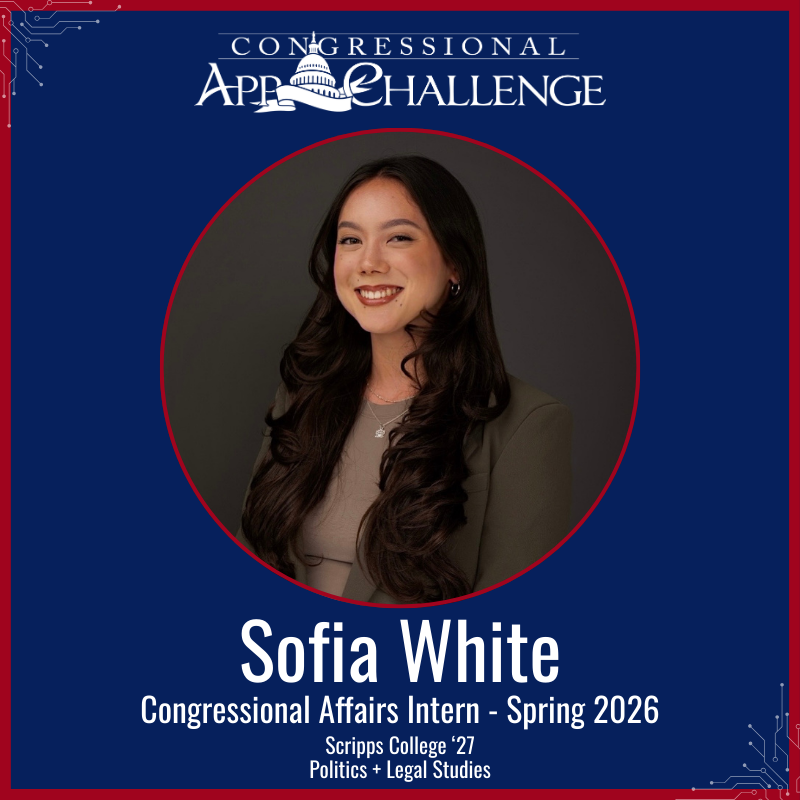
Hi! My name is Sofia, and I’m a Congressional Affairs and Communications Intern from Los Angeles, California. I am currently a Junior at Scripps College of the Claremont College Consortium, studying Politics and Legal Studies. This semester, I am studying in D.C. through the Claremont McKenna College Washington Program!
Why did you want to work for the IEF, specifically the Congressional App Challenge?
As a student at a historically women’s college, I have been immersed in an academic environment where women and students of marginalized gender identities are not only encouraged but expected to pursue ambitious paths in science, technology, engineering, and mathematics. Within the Claremont Colleges consortium, a striking number of my peers are majoring in STEM fields and preparing for technical careers. Here, I’ve been encircled in an environment that normalizes representation in disciplines where these groups have historically been underrepresented.
This experience is complemented by my background at a public high school that deliberately prioritized rigorous science and mathematics coursework. Early exposure to advanced STEM curricula, dedicated faculty, and institutional support made technical fields feel both accessible and attainable. Together, these formative environments highlighted for me the transformative impact of strong K-12 STEM programs. They do more than build technical competency, they cultivate confidence, expand students’ sense of belonging in innovation-driven spaces, and shape long-term educational and career trajectories.
What’s a STEM/internet policy topic that’s most pressing to you?
My work with Los Angeles County, especially learning about Delete the Divide, shaped how I view digital equity. This initiative went beyond expanding broadband; it worked to close gaps in internet access, devices, and digital literacy in underserved communities. By treating internet access as essential infrastructure, like water or electricity, it recognized that connectivity is critical for education, jobs, and civic engagement.
Seeing Delete the Divide’s impact showed me that this work should not stop at the county level. While Los Angeles made important progress, many families across the country still lack reliable internet and the skills to use it effectively. I am interested in exploring how Delete the Divide’s model, public investment, cross-sector partnerships, and targeted outreach could be expanded nationwide to ensure emerging technologies promote inclusion rather than deepen inequality.
On a broader note, I am also interested in AI-driven data center water usage and child internet safety.
What’s the most exciting thing you’ve learned so far during your internship?
In early February, I helped coordinate the annual State of the Net Conference, which deepened my understanding of how many sectors intersect with tech policy. From telecommunications and AI to civil rights and workforce development, the conference made clear that tech policy is not siloed; it influences nearly every aspect of society.
A key takeaway was the importance of LGBTQ+, disability, and cultural affinity networks in shaping more inclusive policy. These groups play a critical role in identifying overlooked barriers and elevating the needs of underserved communities. By addressing highly specific challenges, such as accessibility, online safety, and representation, these networks ensure that policy solutions are more equitable and effective. This experience reinforced my belief that strong tech policy requires both technical knowledge and meaningful engagement with diverse communities.
Fun fact to share about yourself!
I grew up surfing competitively for my middle and high school surf team, and I am now the president of the Claremont College surf club!